 UA30 Site Readiness: Transport Geometry, Setup Dependencies, and a Verifiable Handover
A complete aircraft can pass a purchasing checklist and still arrive at a site that cannot receive it efficiently. The vehicle opening may be lower than the folded aircraft. A trolley may pass through a doorway but fail at the turn behind it. Equipment can be present while the person needed to identify its configuration is elsewhere. These are different failures, and none is resolved by quoting a spray-tank volume.
For a buyer evaluating the UNITED UAV UA30, a useful pre-order deliverable is a transport-to-handover plan. It connects the configuration being purchased to the receiving route, preparation space, support equipment and evidence required for acceptance. This article develops that plan using the current seller's dimension and package declarations. The geometry and scheduling examples are analytical screens, not measured UA30 setup times or handling instructions. The delivered equipment, supplier drawings and applicable manufacturer procedures must determine the actual method.
1. Freeze the configuration before measuring the routeThe current product declaration lists a complete UA30 aircraft, one H12 remote controller, two 14S 30Ah batteries and one 14S 7200W charger in the default package. The public selector separately offers extra batteries, a solid-spreader option and a gasoline-generator option. Those options change what must be received and supported. Their presence in a menu does not establish that they are included in the base quotation.
Create an equipment schedule with a separate identifier, quantity and revision for each supplied item. Record the aircraft, controller, batteries, charger, selected application equipment, cables, cases and any optional power source individually. Distinguish an additional-battery option from the total battery quantity. A photograph can illustrate an arrangement without proving what a specific order contains. The itemized quotation and agreed packing list should resolve that distinction before shipment.
Keep the receiving plan configuration-specific. If the transport case, landing structure or selected attachments differ from the reference used for planning, revisit the route. Do not transfer a clearance conclusion from the bare aircraft to a crated package, or from one supplier drawing to a later revision. Record which configuration each measurement describes so that a convenient number does not lose its original meaning.
2. Treat each folded state as a different envelopeThe current UA30 seller declaration gives three dimension triplets, in millimetres: 1890 × 2120 × 680 with arms and propellers unfolded; 1375 × 1605 × 680 with arms unfolded and propellers folded; and 880 × 760 × 815 with arms and propellers folded. Preserve these state labels when transferring the figures to a drawing or receiving sheet. They are reference dimensions, not packaging specifications or measured assembly tolerances.
One important consequence is easy to overlook: the listed fully folded height is greater than the listed unfolded height. Folding does not necessarily reduce every axis. A receiving team that checks only width can therefore choose an opening that appears generous in plan but is inadequate vertically. Confirm dimension orientation, protrusions and the exact condition of the supplied aircraft against a configuration drawing before treating the figures as a transport envelope.
As a first arithmetic screen, using the first two listed dimensions as the horizontal reference footprint gives approximately 4.01 square metres unfolded and 0.669 square metres fully folded. The ratio is roughly six to one. This is only the area of two nominal enclosing rectangles. It is not a parking-area requirement, rotor-clearance rule, packaging-volume ratio or permission to place six aircraft in the same working area. Access and handling need their own allowances.
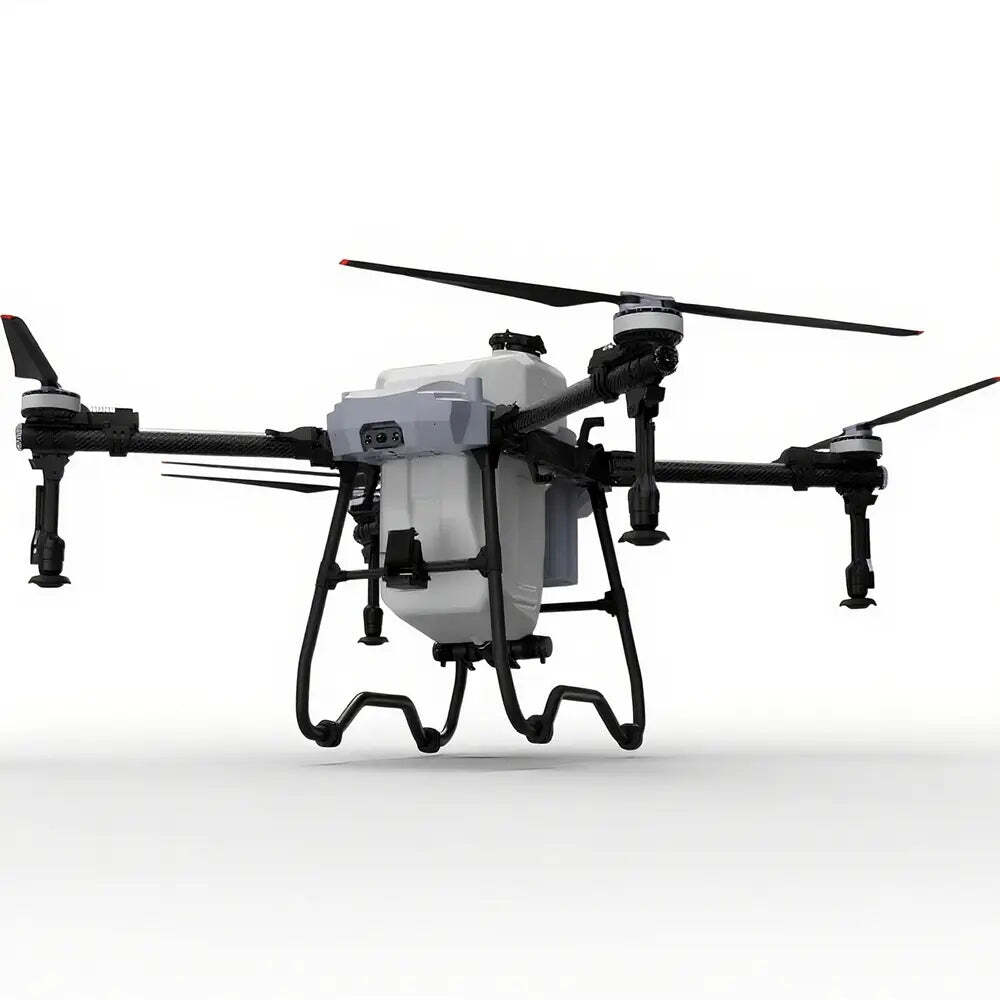
 UA30 catalog reference in an extended configuration. This view identifies the listed aircraft; it is not a folded-envelope drawing, packed-shipment photograph or proof of included accessories.3. Check the narrowest passage, not the largest storage space
A receiving route is a sequence of constraints. Survey the unloading location, approach path, doors, corners, internal passage, staging position and final preparation area. Measure the usable opening rather than the nominal building dimension. Hinges, door stops, thresholds, shelving, trolley handles and temporary obstructions can reduce the available space. Record the height and width at the same physical cross-section so that measurements from different parts of the route are not combined into a fictional opening.
Consider a hypothetical clear doorway 1000mm wide. Comparing it with the declared 760mm folded reference width gives 240mm of total nominal difference, or 120mm per side if centred. That arithmetic excludes packaging, trolley width, protective fittings, measurement uncertainty and the handling method. It therefore does not establish that the delivered package will pass. Replace the aircraft reference with the supplier's actual packed envelope and the handling equipment's outer envelope before making a receiving decision.
Height can reverse the result immediately. A hypothetical 800mm-high opening is 15mm lower than the listed 815mm fully folded height, before any packaging or support equipment is considered. The correct response is to resolve the route and supplied transport configuration. Do not improvise tilting, disassembly or a lifting method from a dimensional calculation; those actions require the appropriate equipment documentation and a competent handling plan.
4. Add a turning-envelope checkPassing straight through a doorway is not equivalent to turning in the space beyond it. A rectangle changes its projected width as it rotates. For an idealised horizontal rectangle of length L and width W, rotating about its centre, the projected width at angle theta is L multiplied by the sine of theta plus W multiplied by the cosine of theta, taking positive magnitudes over the first quarter-turn. The largest projection is the rectangle's diagonal.
Idealised fixed-centre rotation, horizontal rectangle only:
maximum projected width = sqrt(L² + W²)
for L = 880mm and W = 760mm: approximately 1163mm
The example explains why a 760mm nominal width can coexist with a turning requirement larger than one metre. It does not define the actual UA30 handling sweep. A case, trolley, handles, irregular protrusions and the route through a turn may create a different envelope. Sliding and rotating together also produce a different path from fixed-centre rotation. Use a scaled layout and the real package geometry to check the selected method rather than adopting the diagonal as a universal aisle specification.
Include the handling equipment in the same exercise. A suitable route for an aircraft carried by an approved method may be unsuitable for a pallet or trolley. Document what moves, what remains fixed, where the movement changes direction and which person controls it. If the movement cannot be demonstrated on the agreed layout with the real dimensions, the plan is incomplete even when the final room is spacious.
5. Separate storage, preparation and release decisionsThree spaces have different jobs. Storage protects received equipment and keeps its identity intact. Preparation allows the required assembly, inspection and configuration work. The release process confirms that the specified checks and operating prerequisites have been completed. A room or marked rectangle that satisfies one purpose does not automatically satisfy the others. In particular, a nominal unfolded footprint is not a complete preparation-area design.
Prepare a site drawing that shows the agreed receiving route and the areas allocated to equipment, people and records. Include access for the tasks required by the manufacturer's instructions, and keep those requirements separate from this article's arithmetic. The purpose is to discover dependencies before the delivery vehicle arrives, not to publish a generic separation distance or an operational rule for every farm.
The battery and charging arrangements need a distinct review. The seller's default-package description identifies the equipment category but does not settle site electrical suitability, connector revision, permitted charging arrangement or storage requirements. Request those documents for the supplied configuration. A transport plan should not silently assume that an available socket, a familiar connector or an optional generator completes the ground-support design.
6. Model the handover as a dependency networkA single estimate such as “setup takes half an hour” conceals the work that can overlap and the work that cannot. List the tasks, the evidence that completes each task, the person responsible and its prerequisites. Equipment receipt may precede unpacking. Configuration identification may precede a controller review. A final handover decision may depend on several workstreams reaching a documented state. Use the manufacturer's sequence wherever it specifies one.
To illustrate the scheduling method, imagine three independent preparation workstreams. A handling-and-equipment record takes 8 minutes, an unpacking record takes another 7, and a documented assembly review takes another 12; that chain totals 27 minutes. A separate site-documentation chain takes 10 plus 9 minutes, totalling 19. A records-and-controller review chain takes 6 plus 11 minutes, totalling 17. A joint closeout review then takes a hypothetical 6 minutes after all three finish.
With genuinely independent resources and no interference, the idealised elapsed time is the longest chain, 27 minutes, plus 6 minutes for the joint review: 33 minutes. If one person must perform every task sequentially, the arithmetic becomes 27 plus 19 plus 17 plus 6: 69 minutes. Neither result is a UA30 capability or a permitted duration for a required check. These invented durations show how resource assumptions change a schedule. Actual tasks, personnel and duration must come from the delivered configuration and approved procedures.
The model becomes misleading if one technician is assigned to two supposedly parallel branches. It also fails when a necessary document arrives only after the physical work begins. Add those dependencies explicitly. A useful planning sheet exposes who or what is awaited; a coloured timeline that assumes every missing input is already present does not.
7. Define completion with evidence, not a checkbox alone“Equipment checked” is ambiguous. A record should identify the equipment, the check performed, its result, the person responsible, the time and any unresolved exception. For package receipt, this might mean reconciling the agreed packing list with item identifiers and quantities. For configuration identification, it means recording the hardware and software references needed by the applicable documentation. The record should make a later reviewer able to understand what was actually accepted.
Separate a task being attempted from its completion criterion being met. An inspection may finish with an exception. A controller may be present while the required configuration documentation is missing. A dimensional check may reveal that the drawing and delivered case differ. Preserve those outcomes instead of converting every completed activity into a successful gate. An unresolved exception should remain visible to the person making the relevant acceptance decision.
Pictures are useful when tied to a specific question: an identification label, a case protrusion, the available opening or the physical arrangement that was agreed. A collection of general aircraft photographs is weaker evidence for those questions. Retain the relationship between each photograph, configuration and observation date. Avoid using a catalog view as though it documented a customer's delivered package or receiving site.
8. Test the plan against one changed conditionA plan that works only when every assumption is perfect is not yet informative. Change one condition at a time and observe the consequence. Suppose the intended unloading position is unavailable, the receiving opening has changed, an extra case is supplied, or the person responsible for one review is delayed. Identify which tasks and decisions are affected rather than simply adding an unexplained time allowance to the entire job.
The dependency network helps distinguish remedies. Moving a task earlier may help when it is document-dependent and can legitimately be completed before delivery. Allocating another person may help only when the work is separable and that person is qualified for it. Neither action resolves a package that cannot pass the route or a missing configuration-specific instruction. Fix the constraint that actually prevents completion.
Record the assumptions that are most fragile. In a dimensional plan, those may be the exact packed height and the narrowest turn. In a schedule, they may be shared personnel or a document needed before configuration review. Ask the supplier to confirm those particular inputs in writing. A targeted request for the drawing, revision and package condition is more useful than a broad assurance that delivery and setup will be easy.
9. Make the RFQ request the missing interfacesFor the UA30 quotation, request the selected configuration and an itemized supply schedule, followed by packed and uncrated dimensions with their condition labels. Ask for the number and identification of cases, their outer dimensions, the documented handling provisions and the supplied configuration's mass information. Mass is a separate engineering input; it cannot be inferred from the 30L spray-tank label or from unrelated component figures.
Request the current assembly, inspection, controller, battery and charger documentation that applies to the supplied revisions. Ask which tasks can be prepared before arrival, which need the equipment present and what evidence the supplier expects at handover. Where an optional subsystem is selected, request its own item identity and dependencies. Do not treat a menu label as a complete technical specification or a resolved packing-list entry.
Define the handover boundary in the purchase discussion. Receipt, configuration review, training, commissioning and operational release are different deliverables. State which are included in the supplier's scope, who is responsible for the remainder and what records close each one. A signed receipt for boxes should not silently become acceptance of every later operating outcome.
10. Use one configuration-controlled handover recordBring the plan together in a compact record rather than leaving the key facts scattered across email. Identify the UA30 configuration, quotation revision, supplied equipment, dimensional drawing, receiving route, personnel responsibilities, task dependencies and unresolved exceptions. Keep the actual observations alongside the original planning assumptions so that a reviewer can distinguish an estimate from a result.
Update that record when a relevant input changes. Replacing a case, selecting another application subsystem, changing the route or revising the support arrangement may invalidate a previously convenient conclusion. The purpose of configuration control is not paperwork volume. It is to prevent a plan for one arrangement being used as evidence for a different arrangement without review.
The practical purchase decision is whether the supplier and buyer can describe the same delivered system and its receiving-to-handover process clearly enough to verify it. The UA30's listed fold states provide a useful starting point, but the drawing, packing list, route survey and task evidence complete the discussion. That is a stronger basis for preparation than tank size alone or an undocumented promise of rapid setup.
Product reference and quotation preparationReview the
current UA30 product declaration and selectable configurations. For a focused RFQ, provide the receiving location, usable opening dimensions, route layout, handling arrangements and the specific package options being considered. Ask UNITED UAV to confirm the supplied revision, packed envelope, itemized contents, applicable documentation and division of handover responsibilities.
Commercial disclosure: Published by UNITED UAV Official. UNITED UAV sells the UA30 discussed here. Product dimensions and package references are attributed to the current seller declaration. Worked geometry and timing examples are illustrative analyses, not measured product performance. These planning examples do not represent manufacturer certification.

 IRC Chat
 Like Us


